April 30, 2026
Commentary
The Supreme Court struck down this congressional map today:
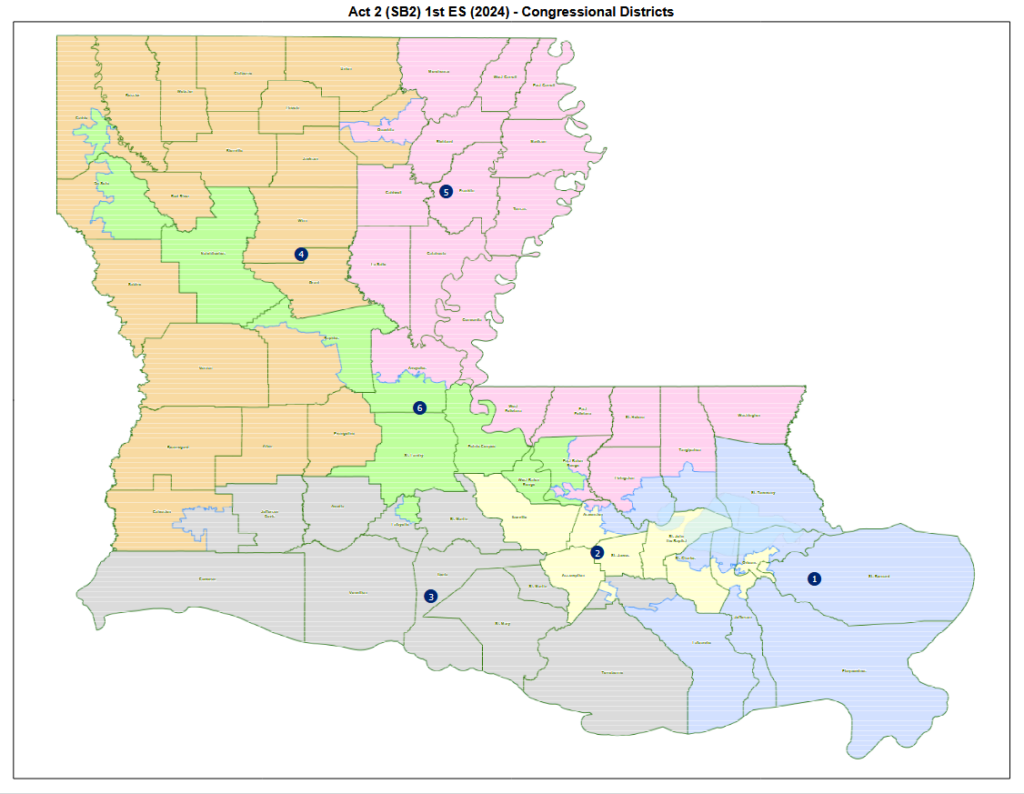

What do these lines mean? What do the boundaries represent in the people that live there?
The Supreme Court struck down this congressional map today:
What do these lines mean? What do the boundaries represent in the people that live there?
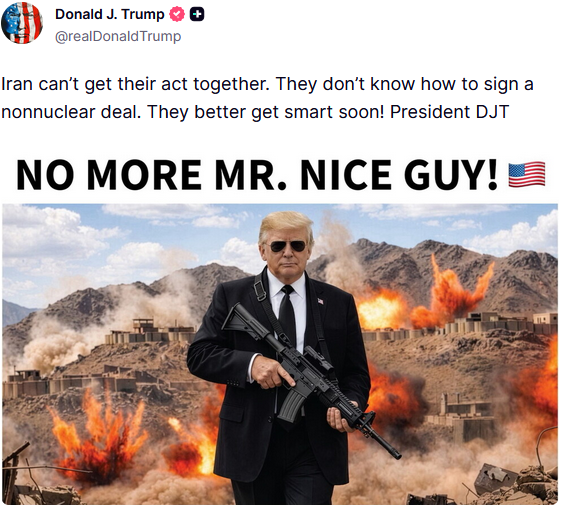
How do you describe this era? It is like post-modernism weaponized. It is like surrealism. Guerrnica but evil. Or maybe guernnica described exactly this sort of time

The town of Guerrnica was a real place. Before WWII, Hitler sent his bombers to the Spanish city of Guerrnica and burned it to the ground after hours of continuous bombing.
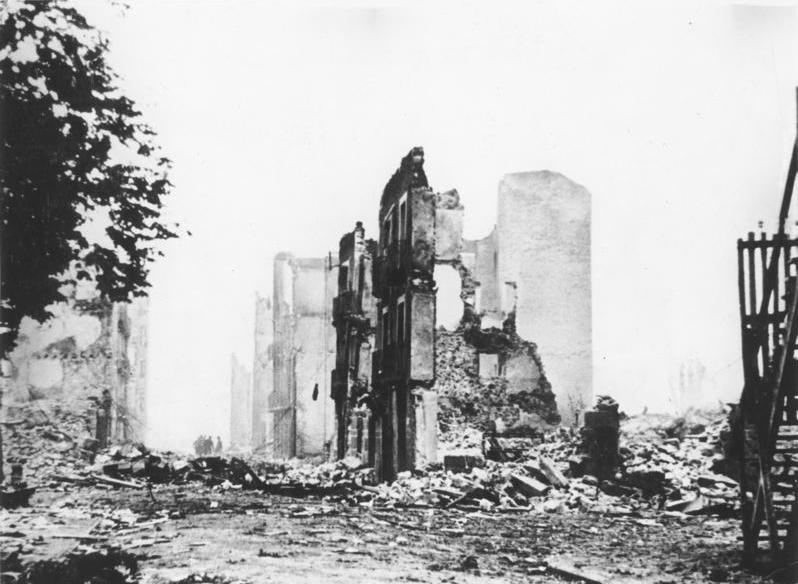

The city was carpet bombed. Some consider this the first carpet bombing in history via warplane.
This month, a number of robots made headlines competing in human sports.
In China, robots competed to complete half marathons alongside humans:

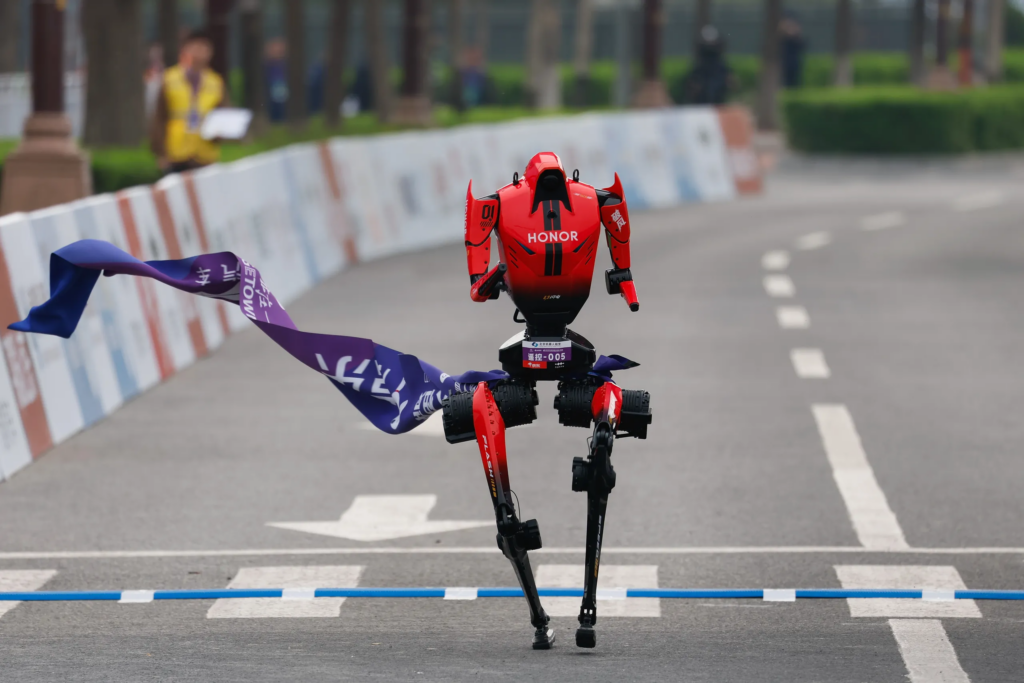
This event marks the first time robots have outpaced humans in a race. The race started at the Beijing Economic-Technological Development Area, with human runners and robots having their own tracks. Someday, maybe they will run side by side?
Robots are also competing against humans in tennis:


Ace, a tennis robot created by Sony, beat professional tennis players under competitive rules. Of course, the tennis robot requires a massive installation surrounding the table with cameras pointed every which way. As per the Guardian: “Ace sidesteps some tricky aspects of table tennis by having an eight-jointed arm on a movable base that does not have to stand on two legs. And instead of seeing the ball with two eyes, it draws on images from multiple cameras that view the entire court from different angles and track the position and spin of the ball.” I’ll be more impressed when a humanoid robot with a single perspective can beat a human competitor.

Still, I am floored by these developments. The robots are starting to look like the ones out of science fiction! Scifi is a form of prophecy, I am realizing.

Recently at a conference called FII in Miami held by the Saudi Arabian Ministry of Investment, the Saudi state-owned chemical company Aramco, and the Saudi PIF investment company, President Donald Trump had this to say about China:
"I must say, I respect China greatly. Because it's amazing that with a system that in theory shouldn't work-- you know we go to school and we go to the best business schools, and we do well in those schools, and we read about free-entrepreneurship and we read about all these, uh, different things, but.. you look at China and how well they do, how well they manufacture-- I mean, they manufacture cars, so many that they actually have a contest for who can manufacture the least cars because they have so many cars. You have to have great respect for China for the job they do. Like them or not like them, you have to respect them."
For context, Trump said this as a non-sequitur to speaking about how “America is the hottest country anywhere in the world.” The question he was asked was “The world is entering a new economic era. Who do you think are the winners and who do you think would be the losers?” Let me respond by hearkening to the recent past.
In 2023, I wrote this short piece about the Chinese Spy Balloon and Attack on Titan:
https://www.aaaahh.net/a-frustrating-balloon/
This particular moment in time (January 2023) filled me with dread, because when this balloon started making headlines, all my previously liberal friends immediately turned into China hawks. Like, all of our discourse became anti-Chinese propaganda, feeding into the growing political current that Biden was an ineffectual commander-in-chief (probably true, as will be discussed below) that was not strong enough to fight the forces of this “axis of resistance” forming on the other side of the planet. Politically, America soured on Biden’s covid-recovery era progressivism and became war hungry. We needed to project power against China, apparently. You know, despite the fact that almost every single object you can observe and touch is made in China and shipped across the world for your convenience.
Well, that same year of our lord 2023 saw Oct. 7th happen in Israel. Biden abandoned his domestic messaging pretty much entirely to become a war president. He was fighting for Ukraine, he was fighting for Israel. He was building forces in the Pacific to counter China. Jingoism was IN! War was exciting again! Yahoo! We ended our occupation of Afghanistan under Biden, but we started two new proxy wars to make up for it. What are we as a nation if we are not constantly burning precious metals and fuel on foreign conflicts?
For obvious reasons, Biden would go on to lose catastrophically to Trump in the next election. Trump somehow simultaneously promised to both end “forever wars” and “finish the job” in Israel and Ukraine. He would talk about expanding the military to one crowd while pandering to anti-war hippies at the very next rally. The actual track record shows that Trump made war in the Middle East constantly throughout his first presidency, including working directly with Netanyahu to try and start an Iran war back in 2019 just before Covid erupted and shut down everything. How could Biden have ever hoped to top that pedigree? Republicans LOVE war. They make a new one in the Middle East every presidential cycle. Yes, that’s right, every single Republican president since the 90s has started a new war. Yes. Yes! Every single one! Look it up. So yeah, if WAR is the MESSAGE, then Republicans are going to beat you in the election. Biden couldn’t even stop Putin from invading Ukraine with a WWII level army. Biden was so weak that Putin could rattle his nuclear saber and just march right in to Ukraine ground-war style, starting a conflict that has continued well into 2026 and could endure “forever.” A forever war. Biden lost hugely to Trump, and the progressive policies he campaigned on all those years ago are now dreams on the wind.
So look where our hawkish tendencies got us this time. We went from expediently loathing China during the Biden era in order to usher in a president that would be “tough” on China. The new Republican administration went in and shuttered hundreds of thousands of government jobs, cut state funding for healthcare across the board, and now actively makes war in Iran. Gas prices have exceeded the very worst of the covid-recovery era. Inflation has not reversed and only increases in growth. And now, Trump is speaking at Saudi state-backed investment conferences where he is declaring that China “must be respected” because its socialism that shouldn’t work “in theory” actually works amazing in practice and has allowed China to become the industrial powerhouse of the world.
In all honesty, I knew almost nothing about China is 2023. I had one Chinese friend, that’s it. Since then, I have come to learn a lot more… and I must say this is one of those areas where I do agree with Donald Trump. Yes, we should respect China! What an amazing, massive place. What a history! What an incredible recovery! From being literally raped, pillaged, and murdered on Holocaust scales during WWII to a thriving country in 2026. The propaganda that China is some backwards evil 1984 dictatorship is falling away before our very eyes. It is being replaced by a new propaganda of optimism for Chinese success. And you know what? I’m all for it. I wish OUR country was producing propaganda about how great it is to live here. Unfortunately, Trump has recently stated that America is so busy making war that it cannot even afford to fund daycare for children:
"The United States can't take care of daycare. We're a big country, we have 50 states, we have all these other people, we are fighting wars. We can't take care of daycare. We got to let a state take care of daycare, and they should pay for it too. They should pay for it too-- they have to raise their taxes, but they should pay for it. [...] It's not possible for us to take care of daycare. Medicaid, medicare, all these individual things. They can do it on a state basis, you can't do it on a federal basis. We have to take care of one thing-- military protection."
And it makes me sick to my stomach because it was so obvious this is the direction we would go in 2023. As soon as Biden began to lose the thread of why he got elected, the slide back into war and austerity began. Biden campaigned on reinvesting in America. He didn’t spout “America-First,” but his message was essentially that we, as the wealthiest country on the planet, should be able to improve the lives of our own citizens. We were going to manufacture our own solar panels and semiconductors. And that was while we were dying en-masse to a pandemic. The world became real for a second, but the moment of clarity brought on by the pandemic has passed. Can we find that progressive optimism again? Or has American Fascism finally stamped the life out of hope? Are we doomed to wage war forever, always navigating some great power struggle between nations on the other side of this fragile little planet we all call home?
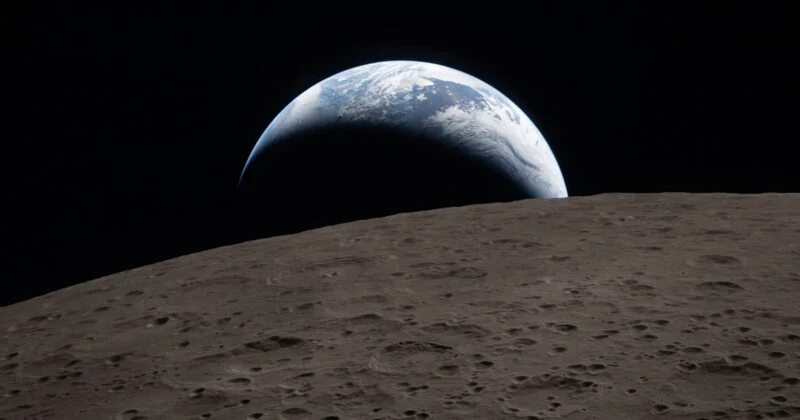
If Iran obtained nuclear capability, the Whole of the Middle East would be under threat and being blackmailed, and petrol and oil prices would soar!. You seem to forget that for 47 years this evil regime has murdered hundreds of thousands of its own people, maybe millions of people!. President Trump has done the World a great favour by being the only one to take on this evil regime!. Only other evil countries would support them!. Even Russia and China should see this!. They will benefit from this regime being removed!. We need stability in this World. A stable and just oil price will bring down the cost of living for everyone on our Planet!
This post is about the second book in Cixin Liu’s Three Body series, “The Dark Forest.” If you are familiar with the theoretical concept of a “Dark Forest” universe, then you already have a sense of what the book is about… but only a sense.
Caution: SPOILERS!
In this book, man finally makes first contact with a probe from another world. The object that reaches our own solar system is small, no larger than a truck, and it is shaped like a droplet of mercury. The following passage describes the moment in which a man-made probe touches the droplet for the first time.
“It was at this point that people noticed a strange contrast: The mechanical arm was obviously designed purely as a functional object, with a rugged steel frame and exposed hydraulics that that felt complicatedly technological and crudely industrial. But the droplet was perfect in shape, a smoothly gleaming, solid drop of liquid whose exquisite beauty erased all functional and technical meaning and expressed the lightness and detachment of philosophy and art. The steel claw of the robot arm clutched the droplet like the hairy hand of Australopithecus clutching a pearl. The droplet looked so fragile, like a glass thermos liner in space, that everyone was afraid it would shatter in the claw. But that did not occur, and the robot arm began to retract” (407, Liu).
This is man’s first physical contact with an extraterrestrial, and humanity is indeed transfixed like a cave man gazing for the first time into the heart of a gem. Up to this point, the alien fleet had seemed to be decelerating while humanity’s new space fleet could reach 15% the speed of light and was growing rapidly. Man was arrogant, riding high on his own progress.
I love the strangeness of the Trisolarin probe. I was absolutely transfixed reading the build up to first contact! As the human probe approaches the alien one, and docks, and latches on… it is so exciting and wonderful! The first humans to physically approach the probe with space suits were amazed to find that its surface gave almost no friction. Under a microscope, they see that its surface is like that of a mirror, with almost no space at all between the atoms that make it up. Doctor Ding Yi finally grabs a rock pick hits the droplet directly. Not a scratch.
“The fact that the droplet did not self-destruct was final proof of what people had guessed: If it was a military prove, it surely would have self destructed after falling into enemy hands. It was now certain that this was a gift from Trisolaris to humanity, a sign of peace sent in that civilization’s baffling mode of expression” (408, Liu).
Cixin Liu sets up a fall so dramatic and obvious. The ensuing fallout is almost hard to read. And yet, the literal melting of the Earth fleet in the open space beyond Neptune is beautiful in its own horrifying way. Humanity was transfixed like fry before an angler fish’s lure, and we paid the price of an entire space fleet for our wonder.
This outcome was foreshadowed, of course. The very beginning of the book starts with a depiction of an ant crawling through the impressions of a tombstone. Despite our hubris, we were only ants to Trisolaris, and our greatest show of force was crushed beneath the abstract boot of a strange space object from 4 light years away. Humanity was simply on another level. It is like a man with a bow-and-arrow trying to take down a tank. The bow user cannot even scratch the surface of the tank, let alone apply any force strong enough to slow its advance.
All told, “The Dark Forest” follows in Three Body’s footsteps in setting up a mysterious alien threat throughout the story and then dropping an awesome alien reveal right at the end. The first book did this too, slowly intimating the existence of the aliens without giving us concrete physical details about their life and culture until the last few chapters. The anticipation of discovery is sublime!
I have already started the third book, and the direction it seems to be going is already so bizarre. Humanity has shipped a frozen human brain into deep space…
No matter how many thousands of years we put between ourselves and our cave dwelling ancestors, some things do not change!
Here is a photograph posted by the news outlet Reuters back in 2023 about Israel’s war in Gaza:

The caption reads:
A Palestinian man reacts as he carries a casualty at the site of Israeli strikes on houses in Rafah, amid the ongoing conflict between Israel and the Palestinian Islamist group Hamas, in Rafah in the southern Gaza Strip, December 7, 2023. REUTERS/Mohammed Salem
The wording here doesn’t describe the picture very well. Instead of describing the man as crying, he simply “reacts.” Instead of carrying the body of a baby, the man only carries “a casualty.” This baby is not a casualty of a war, but a casualty of “the ongoing conflict between Israel and the Palestinian Islamist group Hamas.”
Here is another photograph:

The caption reads:
Women mourn holding the body of a Palestinian killed in Israeli strikes on houses, at Abu Yousef al-Najjar hospital in Rafah in the southern Gaza Strip, December 7, 2023. REUTERS/Ibraheem Abu Mustafa
Again, the women aren’t described as holding a baby. They are holding “the body of a Palestinian.” The woman holding the dead baby might very well be the child’s mother. And the strikes are “on houses.” We don’t know if it was these women’s homes that were targeted specifically, despite the fact that they are surrounded by the casualties of these strikes.
I suspect these captions were written intentionally to avoid emotional language. Since the images are indexed online by the text surrounding them, then it is easier to obscure Israel’s guilt in all of this by keeping sensitive images away from damning keywords like “dead baby” or “crying man holding a slain child” or “casualty of Israel’s WAR in Gaza!”
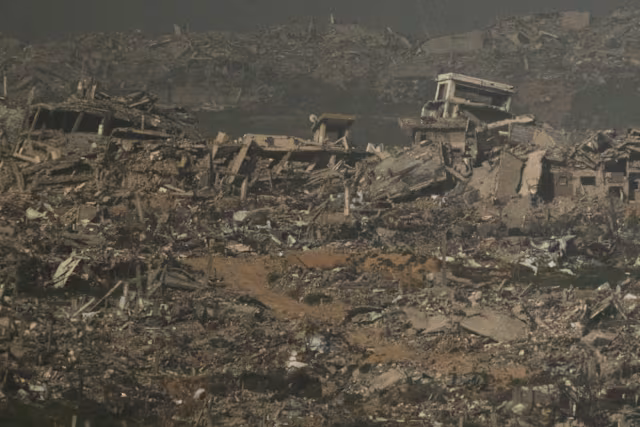
Two years have passed now since these images were taken. Here is Gaza now:
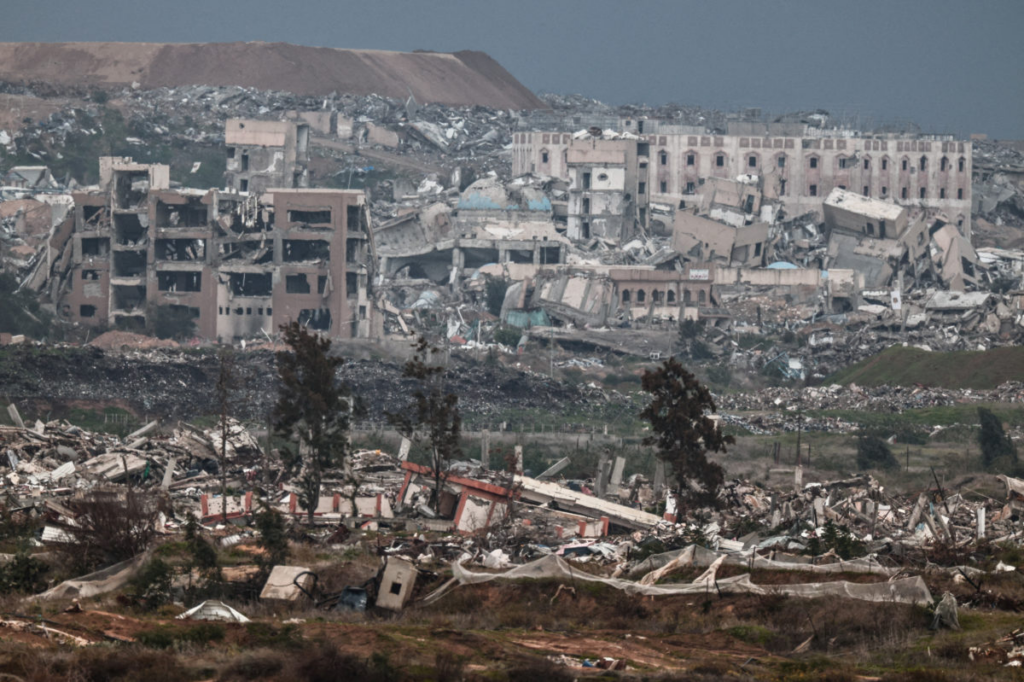
Desolation as far as the eye can see. Gaza is just gone. This was predicted as soon as Oct. 7th occurred, but very little public pressure was applied. These things can just happen, and America, the producer of the munitions that caused this as well as the ultimate defender of Israel against its enemies, will not stop it.
I ate pork, I am screwed.

You know what this means, right? People with Netflix will need to buy a different subscription to watch a lot of movies now. Big wigs with lots of money are carving up the world’s movies and shows, really valuable cultural media from across the decades, and charging a monthly fee for the right to access them.
It is a digital toll road between great movies.
In good faith, will Paramount share with Netflix the right to stream content that they own?
It is embarassing because Paramount’s IP is not even the best of the best. They just happen to be rich, so they can buy up truly great works of art and charge the price of a delicious meal to view them! In an age of infinite light and data moving through the air!

Mike Huckabee is the ambassador to Israel appointed by President Donald Trump. He recently appeared on Tucker Carlson’s show where he bumbled, shrugged, and IDK’d his way through tough questions about Israel and Jeffery Epstein.
MIKE HUCKABEE: How many boots on the ground do you think the US has supplied for Israel over the course of its life? How many times have we put soldiers on the ground for Israel?
TUCKER CARLSON: Well, we had the Iraq War, which was for Israel.
MIKE HUCKABEE: No — not for Israel.
TUCKER CARLSON: How was it for us?
MIKE HUCKABEE: Well, because it was retribution against 9/11. Now, was it the best idea?
TUCKER CARLSON: Was Iraq involved in 9/11?
MIKE HUCKABEE: Our government thought so.
TUCKER CARLSON: Why are 9/11 documents still classified?
MIKE HUCKABEE: I have no idea.
In the year of our lord 2026, members of the US government still use 9/11 to justify the Iraq war, even though former president George Bush has himself called the war a mistake. Ultimately, the government of Iraq had no direct connection to Al Qaeda. While 9/11 was used to justify the start of the war, no concrete evidence has ever surfaced to explain why Bush’s government so adamantly wanted to pursue war in Iraq. In truth, the Bush administration wanted to destroy Saddam Hussein’s government for its own purposes, and the anti-Islamic sentiments of the USA after 9/11 provided fertile ground to justify war.
Now, as the Trump administration builds military pressure around Iran and threatens to commit acts of war against it, we find there is no justification at all. It turns out, you don’t need a grand ideal to make war in the middle east. You can just sort of do it, and leave the fallout to future generations to sort out.
It is 3:37 am on a Sunday and my nose is congested so bad it is as if cement has filled every corner of my sinuses. My ears are pressurized like submarines and my eyes are bloodshot from being rubbed raw. I have just learned what yuri is at the bright young age of 28 years old.
Caution: SPOILERS!!

I just finished listening to Sarah Skaer’s reading of Taiwan Travelogue by Yang Shuang-zi. It is a wonderful travel narrative loaded with descriptions of sights, sounds, and delicious food. Really, every passage is loaded with food, food, food! The travel narrative quickly blossoms into a romance of sorts between the two main characters, a writer on a sponsored trip to Taiwan and a Taiwanese woman hired as her interpreter and guide. Here’s the catch: Aoyama Chizuko is a female Japanese writer and the story takes place in the 1930s, when Imperial Japan was actively colonizing the island of Taiwan and much of East Asia. So, while Chizuko and her Taiwanese friend Chizuru (or Chi-chan) clearly adore one another, an unspoken power dynamic between the two leads to a rift in their relationship that ultimately spoils the romance by the end of the novel. Or does it?
The novel was immediately endearing to me because Chizuko is basically a man that really loves food. Her entire character is about touring around, making stupid jokes, and eating as much delicious food that she can find. Chi-chan, endlessly knowledgeable about her home country and all its culinary delights, is more than happy to see to Chizuko’s every whim. Chi-chan plans trips for Chizuko that are so unbelievably detailed and thoughtful… she plans train rides through seas of clouds with hotel stops and night markets and snack stops… it all feels like a fever dream. And in a way, it is. Chizuko falls head over heals for Chi-chan, and she eventually tries to get closer to her. Chi-chan, however, is willing to flirt but unwilling to cross the line. For Chizuko, her trip to Taiwan is a wonderful writing tour from the “mainland” exploring an exotic place. On the other hand, Chi-chan is a second class citizen, an “islander,” forced to endure slurs, rough treatment, and eventually an arranged marriage in her own colonized land. It is a fever dream.
Again and again, Chi-chan asks Chizuko what their relationship really is. Is she Chizuko’s employed guide? Chizuko insists, sincerely, that Chi-chan is her friend. If this isn’t frustrating for Chi-chan, it was definitely fucking frustrating to me. After being edged along in this magical Taiwanese adventure, I wanted Chizuko to proclaim undying love to this absolute goddess Chi-chan, but in 1930s Taiwan, crossing that line (or even putting the line into words) must have felt impossible. At a critical moment a little later in the novel, Chi-chan again asks Chizuko to define their relationship. Chizuko says that Chi-chan is her “best friend.” Chizuko, literally drunk at one point, eventually falls to begging. She asks Chi-chan again and again to stay the night at her place. Chizuko is powerless to stop the rift that grows between herself and Chi-chan.
Indeed, the word “love” is never uttered in the novel to describe the relationship between Chizuko and Chi-chan. The word hangs in the imagination but is never uttered. This is in line with the definition of yuri as provided by (amazingly) The Ministry of Culture of Taiwan:
“In ACG (Anime, Comics, and Games) culture, the Japanese term “yuri” refers to affection between women that goes beyond friendship but falls short of romantic love.”
Indeed, the relationship between our protagonists is like a supercharged friend-zone. It is a complex relationship described through the subtle movement of dimples, flirty grins, and deep caring for food. Chi-chan is an angel from heaven to Chizuko, but ultimately she cannot give Chizuko what she really, really wants.
The novel ends in with the two reconciled but ultimately dissatisfied. The love they hold for one another is palpable, but it goes unfulfilled by the end. No amount of food can satisfy the sense of want hanging in the air. Indeed, Chi-chan literally takes Chizuko to a special banquet where the two chow down on 9 courses designed to be eaten by eight people, but physically stuffing Chizuko with her favorite stuff is not enough. Their relationship began with food but it transformed into something deeper, harder to satisfy.
In the end, Chizuko spends an entire year in Taiwan with Chi-chan. In the last pages of the novel, Chizuko remembers that she has to return to Japan in a few weeks but doesn’t mention this out loud. Chi-chan, presumably, is going to go ahead with her arranged marriage. The book does not explain what actually happens. We don’t know if love wins, or if they go their separate ways and never see each other again. This ending filled me with so much emotion that I had to write it all down.
So here I am. It is now 4:32 am on Sunday.
FUCK YURI!!!!!
Caution: SPOILERS
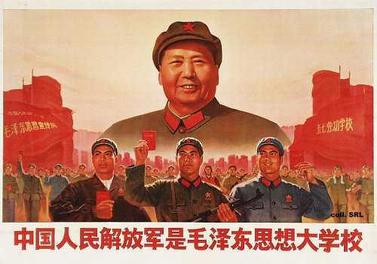
I was surprised to see a fair amount of criticism of the cultural revolution in Cixin Liu’s scifi novel The Three Body Problem. The novel opens with a teenage girl being gunned down from a roof and then skewered on a fence spike. Red Guard militiaman (teenagers themselves, essentially) use the girl as target practice as she slowly bleeds out on the spike. The book describes this period (60’s China) as a time of “madness.” While the book primarily takes place in an unnamed present, Three Body occasionally dips back into the past to explain the wild goings-on of the book’s conspiratorial world. Honestly, I figured you weren’t allowed to portray the cultural revolution negatively in China. That said, Cixin Liu’s book is probably one of the first Chinese novels I have ever read. Perhaps enough time has passed in China that individuals are allowed to criticize the Cultural Revolution so long as that criticism doesn’t extend upward into the modern CCP.
In one of these past interludes during the novel, classified documents relating to a Chinese attempts to communicate with aliens are revealed. The book is very technical, so these documents are presented to the reader as-is. Despite the formality, the human content of the documents is hilarious:
IV. Message to Extraterrestrial Civilizations
First Draft [Complete Text]
     Attention, you who have received this message! This message was sent out by a country that represents revolutionary justice on Earth! Before this, you may have already received other messages sent from the same direction. Those messages were sent by an imperialist superpower on this planet. That superpower is struggling against another superpower for world domination so that it can drag human history backwards. We hope you will not listen to their lies. Stand with justice, stand with the revolution!
     [Instructions from Central Leadership] 'This is utter crap! It's enough to put big character posters everywhere on the ground, but we should not send them into space. The Cultural Revolution leadership should no longer have any involvement with Red Coast. Such an important message must be composed carefully.'
In the book, Red Coast is a fictional organization within China’s military whose sole task is to communicate with space using radio waves shot out of a giant antenna on top of a mountain. The chapters dealing with Red Coast Base are really interesting because they tackle basic questions about interstellar communication that I have never really considered before. If you were to try to talk to aliens via general radio broadcast… what would you send?
The message they ultimately decide on is almost ironically saccharine, but I couldn’t help but puff up with pride a bit at it:
Fourth Draft: [Complete Text]
We extend our best wishes to you, inhabitants of another world. After reading the following message, you should have a basic understanding of civilization on Earth. By dint of long toil and creativity, the human race has built a splendid civilization, blossoming with a multitude of diverse cultures. We have also begun to understand the laws governing the natural world and development of human societies. We cherish all that we have accomplished.
     But our world is still flawed. Hate exists, as does prejudice and war. Because of conflicts between the forces of production and the relations of production, wealth distribution is extremely uneven, and large portions of humanity live in poverty and misery.
     Human societies are working hard to resolve the difficulties and problems they face, striving to create a better future for Earth civilization. The country that sent this message is engaged in this effort. We are dedicated to building an ideal society, where the labor and value of every member of the human race are fully respected, where everyone's material and spiritual needs are fully met, so that civilization on Earth may become more perfect.
     With the best of intentions, we look forward to establishing contact with other civilized societies in the universe. We look forward to working together with you to build a better life in this vast universe.
It reads kind of like a galactic declaration of independence. In hindsight, this passage is emblematic of the hope and striving inherent to the human condition, because the aliens that this message does eventually reach are the opposite of us. The alien world in Alpha Centauri is a blasted landscape orbiting within a three-sun system. The unpredictable gravity of the three body system leads to dark periods lasting centuries. The life that emerged on the alien world had to be hard beyond all measure, slowly developing technology after hundreds of cycles of civilization and apocalypse. By the time of the novel, the aliens have developed an autocratic world where individuals are allowed to live only so long as they can provide value to the civilization. There is no literature or art. Few ever get to mate. When Earth’s message reaches the alien world, the individual to receive it is overcome. Worship of Earth’s culture begins immediately. To them, Earth is a paradise with a calm 24 hour day-night cycle and beautiful weather. It really puts our struggles into perspective!
The Three Body Problem is a wonderful piece of sci-fi. It left me with a lot of questions, but I am going to finish the trilogy before I go probing for answers.
According to the New York Times, Trump said,
“The Republicans should say, ‘We want to take over,’”
“We should take over the voting, the voting in at least many — 15 places. The Republicans ought to nationalize the voting.”
I wanted to hear him say this, but the article doesn’t mention the name of the podcast with former deputy FBI director Dan Bongino that Trump apparently said this on. Nor does it provide a link to it. Or a URL… that’s bad reporting! How can we verify this information ourselves?
I tried to search YouTube for the clip…

Oy vey….
I tried googling around. I found CNN… no sources…
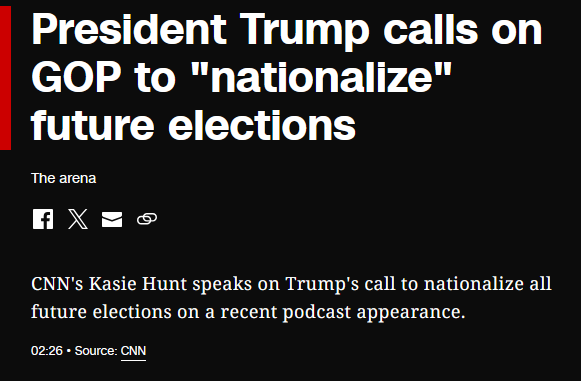
The CNN video had a bunch of boring commentary surrounding the actual voice clips, but they DID have Trump speaking!
Here is the link: https://www.cnn.com/2026/02/02/politics/video/trump-administration-republicans-nationalize-future-election-arena
Trump said it on The Dan Bongino Show here: https://open.spotify.com/episode/4b0rso7ZqI0UEyGZHCNTfh
If some future person reading this finds the above links dead, well… there is a reason your teacher always told you to cite your sources. A link is a temporary thing! It is infrastructure that can fall apart as readily as a paved road will turn to potholes and gravel in a New England winter!
If you want to keep something, you have to download it, which is really the 21st century equivalent of cutting out newspaper clippings.
Regardless, I think the New York Times should provide a transcript of these conversations, if not a direct link or soundbyte.
When you block someone online, there is usually a good reason for it. Toxic behaviors begin to emerge when one uses blocking like a lightswitch.

And yet, this strange tooltip appeared at the top of my Discord window today. I have indeed blocked somebody recently… and Discord dangles the forbidden fruit!

“I watched your prime minister yesterday. He wasn’t so grateful, but they should be grateful to us. Canada lives because of the United States."
“Remember that Mark, the next time you make your statements.”
Russia and China are described as our great “adversaries.” In this rivalry of “great powers,” the United States is supposedly defending the entire free world from conquest by the eastern powers.
I think it is very much in America’s interest to project this reality. A world on the precipice of war doesn’t have time to collaborate on a better future. Preparing for imminent conflicts from every direction does not allow for solar panels or housing projects. Conquest, industry, the extraction of mineral wealth! Rare earth! Oil! Supremacy in AI and Drone Manufacturing! Nuclear Submarines! Those things are valuable in a world at war. A world at war will suspend the liberties of free people in the name of security. A country at war will conquer its neighbor in the name of defense.
This is also the world described in 1984. Orwell’s London is under endless martial law because of “wars” with Russia and China. The citizens of Oceania (as the the American/English dystopian state is called) must be super patriots at all times to support the war effort. The war will never end, because the entire system of power depends upon it.
So, who should Canada be grateful to again? Certainly not to Trump. It was the generation before him (now old and passing on) that fought in World War II. While his peers were dying in Vietnam, Trump dodged the draft. While his peers were fighting for the end of segregation, Trump was being groomed to assume a real estate empire from his family. While Trump’s peers risked jail to build a better world, Trump was fighting his first lawsuits in court to deny black people the right to sign leases in his properties!
It is Donald Trump who needs to learn gratitude! His generation pilfered the Earth while the one before actually fought and died in the name of freedom.