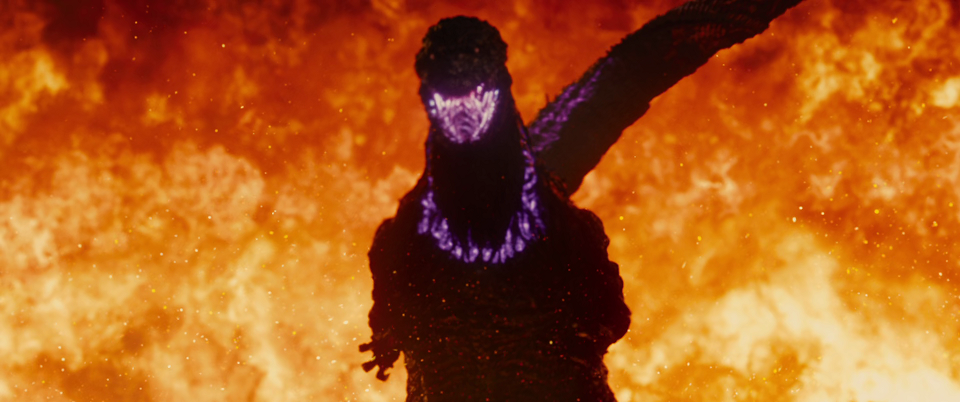
Shin Godzilla is a 2016 monster horror movie from a long lineage of Godzilla movies stretching back to the original “Gojira” released in 1954. The plot is direct enough: a giant monster surfaces in Tokyo Bay, destroying everything in its wake. The Japanese military struggles to mobilize an effective force to counteract the beast, and devastation ensues. As a monster, Godzilla is horrifying in the same way that a great white shark is. White, unblinking eyes gleam out of an emotionless mask of a skull. Not quite dinosaur, not quite lizard, Godzilla stands tall and dark on the horizon like a pillar of volcanic stone. There is nothing cute or animal-like in Shin Godzilla’s rendition of the monster; all similarity to a dinosaur or alligator (so common in modern depictions of Godzilla) are absent. No, this thing is not a giant animal. It is a hulking, unfeeling colossus with a jagged maw and eyes that do not see.
I’ll admit now that I have never watched a Godzilla movie before. I’ve seen Godzilla parodied and referenced in other movies. I’ve played some Godzilla games. But no, until I saw Shin Godzilla, I hadn’t watched a single Godzilla film. You know what I have watched? Neon Genesis Evangelion, the 90’s era mecha-anime about giant robots fighting space aliens.
Shin Godzilla and Evangelion happen to share a director: Hideaki Anno. If you have seen Evangelion, then you will notice that fact immediately. The pacing, sets, and even the soundtrack in Shin Godzilla share striking similarities to the anime. In both works, a government agency is tasked with the impossible mission of fighting an impossibly massive foe. The members of Evangelion’s NERV battle gigantic angels sent from heaven to protect Tokyo. Shin Godzilla’s Japan Self Defense Force is tasked with protecting Tokyo from a giant walking lizard. Agents within both government agencies (Evangelion’s NERV and Shin Godzilla’s Self Defense Force) must work cohesively with each other as well as the members of other government agencies in order to discover the enemy’s weakness before it is too late. Truly, this movie is as much about the interplay of government agencies as it is about individual characters making decisions on-screen. The insides of offices are just as much a set piece as scenes of Tokyo’s destruction at the hands of Godzilla. That’s what Hideaki Anno is really good at: turning tactical meetings into exciting parts of the battle. There is usually a hype drum beat to complement the tactical action sequences.
(full soundtrack playlist: https://www.youtube.com/watch?v=WiONUl3B9po&list=OLAK5uy_mm0hs-zS7fdKdfdRwAbAixovax9k9YgB8&index=2)
The transformation of the government bureaucracy from bumbling/rigid to cunning/fluid across the film is clearly satirical. The Japanese government’s initial response to the emergence of Godzilla in the film is painfully mired in bureaucratic bullshit. From the start, while the monster has only manifested as a pool of blood beneath Tokyo Bay, the government is holding press conferences to deny the existence of a monster. Right up until undeniable footage of the monster is projected onscreen in front of the prime minister’s entire cabinet, they are denying its existence and formulating fake explanations for the phenomenon. When the monster swims up a canal and begins destroying boats, the government holds another press conference stating that, scientifically, the monster could not possibly support its own weight on land. When the monster indeed surfaces and begins destroying the city, the Prime Minister is only able to muster 5 measly helicopters in response. No use–not a single shot is fired. The Prime Minister calls off the attack when a fleeing civilian is detected near the monster. Choosing not to risk even one life by gunfire, Godzilla is able to make a getaway without being met with a single iota of military resistance from the government of Japan. The inability of the government to come to a single decisive response across its many disjointed branches comes off as comical if not horrifying. While people die on the street, politicians in offices bicker about optics and arbitrary rules of engagement with a monster. This part of the movie is very frustrating to watch on the first go around!
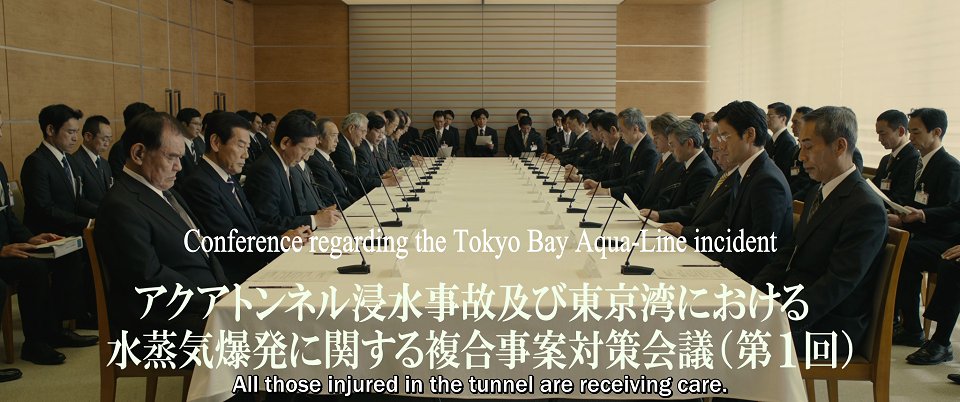
Some might call it boring, but the film is all about determined people working beyond the battlefield to win against an unstoppable monster. Scenes of destruction in the city are juxtaposed with well-dressed government officials studying, collaborating, and responding to Godzilla’s actions in real time. This was the set up in Evangelion too: the command center where the government coordinates its military responses is just as important as the battlefield. And when the monster eventually encroaches upon HQ, the two sides of the movie collide with devastation. Yes, the scene where Godzilla finally makes it to the heart of Tokyo is breathtaking in its portrayal of destruction. Like a nuke going off. One critic, William Tsutsui, writes: “Shin Godzilla leaves no doubt that the greatest threat to Japan comes not from without but from within, from a geriatric, fossilized government bureaucracy unable to act decisively or to stand up resolutely to foreign pressure.” Shin Godzilla turns bureaucratic inaction into horror.
There is geopolitical commentary as well. Throughout the film, America acts unilaterally to attack Godzilla. When Japanese munitions inevitably fail to penetrate the monster’s armor, American B-2 bombers fly in and drop bunker busters on it. The Prime Minister was informed of the attack, but did not himself call it. Nonetheless, he immediately holds a (you guessed it) press conference whose sole purpose is to justify the American intervention, as if the PM has to prove himself to his own people in the midst of a 9/11 level catastrophe. That Prime Minister fucking dies btw, he doesn’t make it to the end of the movie. In another scene, an American politician is counseling his envoy to Japan (a young Japanese woman), telling her, “Japan has grown up enough to have international trade deals on the sly.” America, of course, wants to control Godzilla, and possibly even helped engineer it.
Frustration turns to horror again as the world plans to nuke Tokyo in a last ditch effort to kill the monster before it can spread beyond Japan. This part is heart wrenching, and I’m not even Japanese. The thought of dropping thermonuclear bombs on a city, to sacrifice all those people and all that land just to maybe stop Godzilla, is a titanic burden. Doubly so upon a population that already bears the trauma of being nuked twice before. I found myself feeling profoundly sad at the possibility that this might happen on-screen… strange emotions for a Godzilla movie!
Yes, this is a strange movie. I have seen nothing like it outside of Neon Genesis Evangelion. Hideaki Anno is a genius! If you have the patience for a monster movie with comparatively little monster and lots of dialogue, you might just fall in love with Shin Godzilla like I did. Or, if you are like my roommate Max who prefers when monster movies get straight to the big fights, then you will probably glaze over for most of the talking scenes. That’s okay too, because what we see of Godzilla itself is incredible.

I won’t spoil too much here, but Godzilla’s design is awful in a terrifyingly awesome way. The monster actively evolves throughout the film, changing its genome in real time to go from a giant aquatic lizard to a freakish bipedal dragon from start to finish. Godzilla’s arms are small, almost vestigially weak hanging above titanic thighs that seem barely to heft the bulk of the beast from footstep to footstep. Godzilla’s skin seems to ooze like hardened magma. The monster has no emotion–its face and jaw appear fixed into an unblinking snarl as if they were literally caste from molten obsidian glass. The unblinking part is probably the most striking feature. Two fish eyes peer out of Godzilla’s head. They don’t rotate or look around. They don’t seem to track movement at all. Don’t be fooled, however. The capacity to annihilate all life lurks within Godzilla’s lumbering form. The shark metaphor is apt.
I will watch more Godzilla movies and see how Shin Godzilla compares. I have a feeling this movie is one-of-a-kind though.