Historic Route One is possibly the most lamented object on the North Shore. Talk to anyone, take a ride with somebody that grew up in the last century, and you’ll get the whole mirage tour. They’ll point to a Yankee Candle and a Starbucks along a particularly forested bend in the road and tell you, “that’s where the pirate ship was.” It was a real ship, masts and all that. There used to be this Chinese pagoda castle thing up on a hill. Weylu’s. Oh, and you can’t forget Kowloon! Pure Orientalism, you couldn’t get away with building something like that in 2021.
The dinosaur gets people the most. A statue of an orange T-Rex that stands upright (as dinosaurs did in the olden days) once marked an ice cream and mini golf place. The dinosaur is still there, propped up on the massive grey brick threshold of some mega construction project. Obviously, it’s not the same. You used to be able to, you know, stop and play mini golf. The dinosaur scared the shit out of me personally, but I always looked for it on the drive to Malden.
That’s the thing, the highway magic isn’t totally gone. As you drive along Route One, you’ll notice that the road is a bit funky. Prince Pizzeria has a model Leaning Tower of Pizza coming out the top of it. There’s an Italian restaurant with a mobster hat on the sign. A giant cactus declaring “HILLTOP” used to mark a pretty good steak house. These magical accents are just that–accents, little details that blend into the growing number of Super Walmarts and the plastic outlets. There was probably even more of it before I was born, but the magic is shrinking every year. The sign of the Square One Mall, once brightly colored red and blue, has faded pink and inscrutable.
It’s not like Route One is an unpopular roadway, either. Try to get from Revere to Middleton at 5pm on a weekday and you’ll see what I mean. Killer traffic. People are driving, but I guess they aren’t stopping as much. It’s hard to own an independent business these days, and the big money Super Walmart people are busy buying up land and transforming it into concrete cubes lined with plastic. They might keep the fluorescent dinosaur around as a token with a plaque, but today’s Route One investors have no interest in making something new to match the creativity of the past. That is what irks me the most. If you are going to build something on this stretch of road, why not do something out of the box? The greatest way to uphold the magic of the past is to invest a little magic into the future.
A shadow had fallen over the town of Middlebury. In the span of a single week, two of Middlebury High’s most lauded students went missing without a trace. The first was the athlete, the star of the woman’s soccer team and the apple of the National Honors Society’s eye, Kasandra Nievo. The second, Eric Davidson Jr, first child of local dairy baron Eric Davidson and universally respected president of his class, went missing only days after. These disappearance injected a palpable anxiety into the spring air of Essex county, and one could not drive more than a few streets in any direction without confronting missing persons posters and flashing LED signs.
A poem entitled Big Fight
Love her but
she’s a bastard.
Should have thought faster
(or at all)
before the slammed can
made the stairs a dump.
Wet wipes, ripe
pad streaked brown,
refuse, expletive.
Fists on hips,
sinewave curve,
black hair
like wire.
Taut cheeks,
defiant gleam,
electrifying
eye on fire.
Rebuked.
Cauterized.
Proselytized.
We’re about
the same height but
her thighs would crush me.
Sullen, I
jerk off in the corner.
From Apocalyptic Review: Neon Genesis Evangelion
Every once in a while, a piece of media will be leap into the public conscience like an atomic blast. Although “Mecha” was already a popular genre in Japanese manga and animation for decades, the release of Gainax’s Neon Genesis Evangelion in 1995 exploded the popularity of both giant robots and anime across the world. Americans were already familiar with their own soft brand of fighting robots with the Transformers franchise of toys and television shows, but Neon Genesis Evangelion was something else. It’s intentionally short episode count allowed for a quality of animation rarely seen outside of feature-length animated movies, and the show’s intense themes of apocalypse, authoritarianism, and psychological turmoil added weight to a genre previously dominated (in American eyes) by the likes of Astro Boy and Optimus Prime. It is a wonder of worldbuilding and kinetic action. With the show’s rerelease on Netflix in 2019 with an entirely remastered dub, we are finally allowed a legal method by which to experience the cult classic paradigm shifter for ourselves.
As an example of popular apocalyptic media specifically, Evangelion portrays a bizarre blend of Japanese atomic apocalypticism in a futuristic/cyberpunk setting and, as its name implies, Christian evangelicalism and biblical occultism. The anime is decidedly dispensational in its vision of the end of humanity, and its invocation of epic battles with angelic beasts and the resurrection of Godlike beings seems to pull images and themes from Revelation at will. Though Christian imagery is loaded throughout the anime, the depths of the show’s fascination with rapture are at first cleverly disguised by the typical Mecha formula. The world of Evangelion takes place in the Japan of an imagined 2014. The story follows Shinji Ikari, estranged son of the inventor Gendo Ikari, as he arrives in Tokyo-3, a technologically advanced metropolis built upon the ruins of the old city. Fourteen years prior, the world underwent cataclysmic change after an explosive event known as the “Second Impact” melted Antarctica, shifted the world off its axis, and plunged the Earth into climate catastrophe and war. Though Tokyo-3 appears lush and affluent, the heat of the city is seemingly equatorial and a natural ambience composed of deafening cicada chirps indicates an ecosystem that is unbalanced and only recently vigorous in its repopulation of the planet. In the first episode, these elements are only accents—the contemplative tone of the initial moments are undercut by sirens urging the Tokyo-3 into lockdown. An angel is descending upon the city!
[…]
We see in Neon Genesis Evangelion a merger of apocalyptic traditions that is rarely seen. On one hand, the anime certainly follows the tradition of contemporary Japanese apocalypticism inspired by the dropping of the atomic bombs on Hiroshima and Nagasaki. Animated films like Akira (1988) render a futuristic Tokyo created in the aftermath of an incredible explosion. Evangelion’s brutal architecture of apartment complexes and skyscrapers seems to adapt this popular aesthetic, including the foundational imagery of explosions to kick the plot off. Unlike the American nuclear terror, Japanese nuclear apocalypse is often framed in the aftermath of disaster rather than a buildup to the blast. However, Evangelion mixes Christian rapture culture into the formula. The show contains a Mecha-apocalypse that is entirely aware of its own course. Plot becomes prophecy, and considerable pleasure can be derived from piecing the events together, especially in repeat viewings.
Evangelion is an anime that unfolds. Once you really get into the world, the show drags you straight to its violent conclusion. Though I originally set out to watch the anime for its striking animation quality, I found myself increasingly drawn to the convoluted plot and religious imagery. The show pretty much begs you to binge-read the wiki afterwards! The lore and iconography go incredibly deep. It is also a particularly relevant piece of media for our current disinformation age. The reality of Tokyo-3 is ruled by conspiracy and lies underscored by an insatiable appetite for an Evangelical reckoning. Imagine a version of Q-Anon that spoke of giant angelic monstrosities and a scientific method of inducing rapture via giant God-robots… that’s sort of like Neon Genesis Evangelion. In a lot of ways, the show can be really upsetting. Though it adopts Christian ideas about the end of the world, I must warn you that the end of Evangelion is far from happy. The New World that this rapture brings about is far from paradise.
Keeping up with politics is important. It’s also incredibly difficult. Not only are the day to day movements of politicians and pieces of legislation really emotionally taxing, the general pace of law making is very slow. For example, the bill that I have been eyeing for months, H.R.1 AKA the “For the People Act of 2021,” was introduced to the house back in January and only recently saw any kind of decisive action in the senate today. Your average person doesn’t have that kind of patience (hence the value of good journalism to keep us up to date, but I won’t get into that now lol). Well, if you want to stay informed, I recommend making a habit of discovering a piece of legislation you are personally interested in and keeping up with it. Become personally invested in a law! There are great websites you can do this with, including the official government site for congress.
The above link leads to the summary page, which gives a handy outline of the bill’s contents. If you want a deeper look, however, you’ve got to find an analysis or read the legal jargon of the bill itself. The website also lists actions taken on the bill. It’s a little out of date as of writing, because the senate just shut down the whole process with a filibuster. That last bit has me upset for a number of reasons.
H.R.1, among other things, attempts to ensure mail-in ballots, force redistricting to be carried out by nonpartisan commissions (redistricting happens every 10 years and is used to gerrymander voting districts to, frankly, allow Republicans to be way over-represented in congress despite lower numbers), and limits campaign spending from foreign nationals. It also allows for automatic voter registration and expands early voting. It has been criticized by the Fox News universe for allowing folks to vote without any form of ID. This is false. While the law eases up on ID requirements (which can already be bypassed easily in most states that require it anyway), the law does provide a provision that requires voters without ID to sign a statement. In the event of an investigation into election integrity, this statement can be traced. Of course, fraud is historically a nonissue in elections despite the insane claims of the previous president.
In short, the bill is awesome. It does everything I have ever wanted a voting bill to do. The stuff about gerrymandering specifically could seriously improve the political landscape of the united states and force campaigning politicians to tackle real issues rather than rely on cheating their constituents into a majority.
It occurs to me that not all that many people really understand what a filibuster is. Some have this notion that it is a last ditch effort, an emergency tool, to shut down legislation that might be bad. Literally speaking, filibustering is the act of giving a speech on the floor that never ends, so the process of congress can’t go on. It gums up voting and pretty much kills a bill. You can do this by spewing nonsense for hours on end at the pulpit. Bernie Sanders has some pretty epic filibusters:
Bernie’s filibuster actually talks policy, which is impressive. Other filibusters can be truly nonsense.
The thing is, filibusters are not generally used as an emergency measure. It is common practice on the senate floor these days, and it tends to come out immediately. In this case, the republicans have chosen to filibuster the voting bill. This means that the bill isn’t even going to be discussed or debated. Your elementary school vision of the legislative process probably involved rigorous debate. Senators would argue their case, call up experts to comment, and show charts of data to back up their claims. Well, that isn’t what actually happens. The modern senate either votes or doesn’t. There is no healthy discourse, no discussion. It is brain dead. This system is dysfunctional, it does not encourage intelligent, rational discussion of laws.
Now, you may be thinking, “Gee Aaron, I can appreciate this perspective, but why can’t the proponents of H.R.1 just compromise to get the bill passed?” Talks have been had, of course. The republican discourse on the bill, however, has been entirely bad faith. Many republican senators back Trump’s claims that our elections are fraudulent, abd Mitch McConnell recently dismissed the bill as a simple power grab without seriously debating its actual components. They aren’t going to talk about it. Unfortunately, this dynamic is pretty common. In the event of redistricting, republicans would have to seriously change their platforms to actually attract new voters to win elections, so their obvious response is to use the easiest tools available to destroy the bill at inception. To them, this bill is life and death. A shame, I say!
I will be monitoring these events further and will provide comment if the situation changes. The calls to end the filibuster continue. Both parties have been pretty egregious in their exploitation of the filibuster, so I think it is time to rethink that whole process. At the very least, there needs to be serious debate on the senate floor. We can’t let these zombie politicians continue to eat our tax dollars while not doing their job.
(The following is an article I wrote back in February for the Brandeis Hoot. I’m not sure if I’m allowed to just move my writing around on the web, but I never signed any agreements so I’m pretty sure they have no power over me.)
The pothos, Epipremnum aureum or “devil’s ivy,” is the gem of the novice planter’s world. Observe the allure of its emerald leaves, waxy spades flecked in gold and the subtle spiral of its endlessly unfurling tendrils. A king of propagation, the pothos is undaunted by carelessness and such paltery forces as sunlight and entropy. If the water flows, so do the leaves, and it is for that reason that the golden pothos is the perfect addition to your depressing holdout in East.
Plants are a delight rarely afforded to college dorms, and that is a shame. Humans and plants are kin, and the mind is greatly enriched by the sight of healthy growth. We campus-going Brandeisians have at our disposal a wealth of gardens and forests within exploring distance, but the time to appreciate these things is often limited. Given that most students aren’t going to shell out cash for high wattage CFL lights and timers, keeping an indoor garden is seemingly impossible. This is where the pothos shines; the plant will remain green and lively even under extremely dim circumstances. It is said that the plant is called “devil’s ivy” because of its uncanny ability to remain bright and attractive even in darkness. It will certainly endure the caustic atmosphere and cave-like setting of the average dorm.
If this plant sounds familiar, that is because you have certainly seen one (if not hundreds) over the course of your life. The hardy specimen is likely one of the most popular houseplants of all time. They adorn the secretary desks of offices around the world. They hang from shelves and windowsills. The pothos rivals succulents for their ease and accessibility in the plant-care hobby. Next time you find yourself in an office or department store, keep your eyes peeled for a vine-like plant that droops from the pot in tangled curves. The heart-shaped leaves covered in a glossy finish will give the plant away. Once you know what it looks like, you will find pothos everywhere.
Growing a pothos is a secret pleasure of mine. A windowsill or a desk lamp is all the plant requires in terms of lighting. In my experience, the light doesn’t even need to be direct. The winter light that streams through the southeast facing window of my Mod has provided ample sustenance for my own pothos, and, judging by the emergence of fresh leaves toward the back of the plant, even the ceiling light seems to be enough to encourage fresh growth. Watching these leaves form has been a pleasure. New leaves unfold from existing stems like spontaneous paper butterflies, and the stems follow in an unfurling loop. The branch of a tree separates at a single point and grows outward like a spike, but the pothos unfurls new shoots like ribbons peeled from its own flesh. Disgusting image, beautiful result. The leaf and stem connect at two points along the father branch before snapping off and blooming into a glossy new heart of green.
You don’t even need soil. The pothos is aquatic, and it will take root in a jar of water. If the specimen you purchase happens to come with soil, then you do not have to overworry about overwatering; moist soil will not bother this plant. Drench the soil, let it sit for a week or two and the pothos will grow. Stem clippings placed in glasses of water will propagate entirely new plants, so sharing the love is easy. My own little dorm experiments are doing swimmingly! It is not uncommon for hobbyists to grow pothos from the top of freshwater aquariums to act as a natural devourer of nitrate. A vase of pothos is sort of like a vase of roses that doesn’t drown itself or attempt to stab you. My only advice is to let your water sit between waterings/refills in order to allow the chlorine in your tap water time to dissipate. Then again, the pothos can probably survive chlorine. Hell, these things could probably outlast a nuclear fallout.
An old pothos is like a tangle of living hair, a tendril mess of emerald growth that always overflows its container. The leaves, like frozen tears, hang erect from their verdant arms. My plant is still small. The leaves burst from the soil on solitary stems like a carpet of flat hairs, but already the process of splitting stems has begun. I eagerly await the day that my child will reach toward the carpet with locks of photosynthesizing potential. Each plant is a prophecy, a promise of clean air and happiness for the price of nothing. In the case of the pothos, the price is literally nothing. It is an abuse retardant creature, a flora that will forgive your failures for years on end. Do not delay! Find a snippet of this awesome plant and kickstart your own personal journey to tender bliss. Your drab room is desperate for it.
I was boiling up a plate of spaghetti when my mother came inside and mentioned that she saw cherries at the supermarket. I would have left right there, but the pot still had pasta in it so I resisted my impulses. As soon as dinner was finished, however, I rounded my brother up into the crossover and hit Market Basket.
That’s right folks, the summer cherries are finally reaching east coast shelves. In an era when nearly any fruit can be had even in the heart of winter, cherries remain a rare treat. I’ve never had a good cherry outside the months of June and July! Most fruits are best enjoyed in their season, but cherries are really something else. I spend a good part of every year thinking about cherry season. When it finally arrives, I eat cherries until I am sick. I’m sick right now.
The darker the cherry, the sweeter. I usually love sour foods, but I definitely prefer the blacker cherries. I don’t know about fresh picked cherries, but the dark ones that finally reach New England tend to be nice and soft. They have a tendency to explode, so do not dress nicely while eating.
I’m still mad. I was playing Super Smash Brothers Melee rather than looking for work as usual when I suddenly thought about Trump’s messed up presidency again. I recalled a distinct discussion I had with a friend of mine in which he argued that Trump had little to do with the intensity of the pandemic. In his eyes, the stupid bastards that weren’t going to maintain social distancing or wear masks were going to screw everything up anyway. To an extent, there is merit to this idea. Keeping Americans tied down to common sense rules is about as easy as getting a knife on a rabid eel. The thing is, we could have started preparing for the pandemic and closing international travel MONTHS in advance.
I remember a distant spring when the Democratic primaries and the impeachment were the things I was most concerned about. I was reading the newspaper every day, keeping up with politics, and generally being a really put together person. You know what made it on the NY Times front page multiple times in January? Yes, the coronavirus. As the confirmed cases in China mounted, the sense of urgency within these articles grew. When it came out that Trump was briefed about the severity of the virus back in January, I wasn’t particularly surprised. If you read or even watched the news at any point leading up to March, you probably would have gotten some idea about this thing (though Fox News was calling it a hoax at the time, big surprise). Of course, since the government was doing fuck all to prepare for the thing, I assumed corona would just be another swine flu, something that made the news but didn’t actually affect me in any way.
Want to see propaganda in action? Fox News watchers across the nation are losing their shit because of a federal investigation into the origins of the coronavirus. The lab escape theory, which we had no reason to give any attention to a year ago when we were literally trying not to die by going to the grocery store, is now very popular, and Fox News fans are now using it as a corona-gotcha. They are patting each other on the back, giving each other reach-arounds and shit. Well, guess what buddy. Conspiracy or not, we still knew about the virus for months and didn’t do anything to prepare for it. Our production was totally caught off guard, and thousands died for it. The conspiracy theory I want investigated is whether or not Trump was sucking Xi Jinping’s dick when he was told to ignore the manufactured virus and let America crumble in its wake.
Our nation should be better than this. While a pandemic-tier virus was brewing in China, our popular TV news networks were manufacturing outrage and political discord. It’s literally killing us. People die when we twiddle our thumbs and turn every important issue into a Dem VS. Repubby screaming match.
Folks like to debate whether Orwell or Huxley’s vision of the future is more accurate. They are too sophisticated. I think Idiocracy is probably the winner. That’s not a particularly innovative take, I know.
Ayep, that’s just the state of things. I have no idea how we are going to resuscitate a broken media culture in this nation. Guilty Zoomers like to argue that individual responsibility is worthless and large scale legislation is the only way to fix anything, but I think making individual efforts to change habits and continuously fight the zombies is important too. Even if it doesn’t matter in the end, at least you can say you were awake to the last breath.
That’s right, here’s another segment on politics. If you are easily enraged and/or possess bad opinions, you should probably stop reading now. I have more interesting content elsewhere and upcoming.
Sometimes I like to think about the various ways our media failed to convince people that Trump was a bastard. It shouldn’t have been hard. The shit that guy was spewing daily should have tipped off a lot more decent people that something very wrong was happening to our nation. I suppose it is more than possible that a lot of decent people are also closeted shit eaters, but you also have legitimately thoughtful people tolerating an idiot. I think a primary cause of the wide scale Trump blindness was the simple fact that the majority of people don’t read the news. A lot of people don’t really watch the news either, and your weekday morning TV newscasts just aren’t going to report on anything that isn’t a major press conference or a crime.
Keeping up with the government with your standard news programming is like trying to read a book under a white strobe light. Anyway, when people do watch the news, it’s probably Fox News’s opinion programming. To most Americans, Tucker Carlson is the news. Last I checked, his show was the highest rated on television, clocking in at over 4 million viewers last June (go check Forbes). Fox News played long segments of Trump speaking as little as possible, for obvious reasons. If you try to extend Trump’s pithy sound clips, you reveal nonsense. The “Sleepy Joe” memes that buzzed around the 2020 election would irk me because just two minutes of hearing Trump speak reveals a level of dementia that made my own poor grandmother (god rest her soul) sound like she was giving a college lecture.
The main thing I want to stress in this post is that America’s disenfranchisement from strong journalism is not accidental. It’s tactical. Smart politicians have been picking away at the public perception of journalists for decades, and we are starting to reap the fruits of this effort. Vast news deserts are spreading across the nation, where local reporting is dead and only national level news is available. People start to drink up the Fox News/CNN Koolaid and lose sight of reality. This is great for politicians, who don’t have to sweat about investigative journalists revealing their dealings. The drop in revenue to real reporting institutions like the NY Times means that they have less funds to field journalists abroad. This is really bad for wartime newsgathering, because it’s freaking expensive to send independent journalists into the battlefield. During the Iraq war, resources were so low that a government program to send journalists with platoons was devised. In theory, the journalists could be tactically shielded from illegal, unethical, or bad-optics movements overseas. Imagine Vietnam without cameras! Well, we are still shooting people across the Atlantic and nobody really talks about it, so I suppose it’s working.
I could write a really substantial analysis here filled with facts and citations, but I’m more interested in bashing Trump. You might remember (or probably don’t) the failed 60 Minutes interview that Trump had with Lesley Stahl. During that interview, Stahl reminds Trump of a thing he said to her in response to a question about his use of the term “fake news.” Trump apparently said:
“I need to discredit you [the media] so that when you say negative things about me, no one will believe you.”
Beloved president Nixon once famously declared, “The press is the enemy.” The scary thing is that Nixon got axed for breaking the law, but modern politicians increasingly walk free from criminal and unethical activity. Trump committed Watergates like it was his job, and no amount of journalistic outrage stopped him.
Journalist bashing is old. Even good old Teddy dedicated a long speech to complaining about the “muckrakers,” the investigative journalists revealing the maladies of meatpacking, the monopolization of oil, and political bosses. In high school, we are taught that Woodrow Wilson was the happy go lucky WWI president that wanted to unite the world in his League of Nations. We don’t learn that his Seditions Act of 1918 allowed him to silence any piece of media that represented the government in a bad light. Straight censorship of the press. Don’t get me started on the 1950s.
The disaster scenario that Trump’s largely unpunished term represents is one in which the press’s role as the people’s watchdog ceases to be meaningful. The institution of journalism crashes into a heap of smarmy assholes running opinion shows and sensational reports on violent crime. Of course, good journalism is far from dead. I’d like to end this rant as I always do, by encouraging you to seek out informed news outlets and turn off Twitter. When grandpa starts huffing about the latest Fox News scandal, kindly remind him that too much TV will turn his brain to mush.
A functioning Democracy needs journalists! I fear a lot of Trumpies don’t actually give a shit about Democracy so long as they can wield some power over others.
Eileen’s settlement, the Nether portal, and the chicken house. In the distance, my sunflower field.
At long last, this protracted monster of a research project is complete. The final document weighs in at an obese 81 pages containing 26,279 words. How did I write so much? Don’t ask me, I have no idea!
Really, though, it is difficult to describe large writing projects. From what I have read, every writer tackles an assignment differently. Some people have godlike self control, writing a single page a day for months on end. Others produce hundreds of pages in manic spurts. I’m not that bad, but I was shocked to find in my feedback that the best segments of the essay were the parts that I felt were rushed. I wrote those segments in a fugue, basically. In hindsight, I don’t think it was a trance that made those pages successful–my best research, my most novel ideas, and the subjects I was really interested in were in those parts. I think passion won the day there. It’s easier to write when you love what you are writing about.
Title: Minecraft and the Digital Robinsonade
So, what is this massive project all about anyway? I have been hard pressed to describe it to people because, besides the surface subject matter, it is actually quite boring. Most theses are. In essence, my thesis is about Minecraft and Robinson Crusoe. Specifically, my thesis presents an analysis of the uses of robinsonades (a genre of novels based on Robinson Crusoe) in education, ultimately implicating Minecraft within that didactic framework. The essay is particularly cool because I can throw around vocabulary like “didacticism” and “pedagogy” and not feel like an idiot. As it turns out, robinsonades have a long history in education that you are probably familiar with. There is a reason every kid reads Lord of the Flies in high school. I basically lay out a history in the essay that traces the evolution of the robinsonade from its origins as a socializing tool in the late 18th century to full blown literature of empire, colonial handbooks, by the height of the 19th century. Then, I explore how more contemporary entries to the genre criticize its colonial roots and ultimately shift their focus toward developing an environmental ethos within the reader. Minecraft, being a survival game about settling and managing land, fits into this robinsonade scheme perfectly, and I try to show how the development of Minecraft mirrors of the evolution of the literary genre to emphasize gameplay objectives that mirror the 19th century robinsonade. I conclude the essay with a discussion of my favorite mod, Better Than Wolves, which forces the player engage with Minecraft’s inherent colonial themes overtly while simultaneously laying the groundwork for a slower paced, more environmentally focused form of gameplay.
That’s a decent layout of the jargon. I intend to produce a series of small posts highlighting my most interesting findings, so stay tuned for that. Now that I am all wrapped up with my coursework, however, I hope to resume uploading content more regularly. The desperation of this ridiculous finals period had me drawing some pretty lurid art pieces, so I am going to try to get those scanned and uploaded eventually. My long dream of publishing a pornographic art blog might finally come to fruition! Aaron’s Vintage Pornographics!
(if you would like to see the original aquarium setup post, click here)
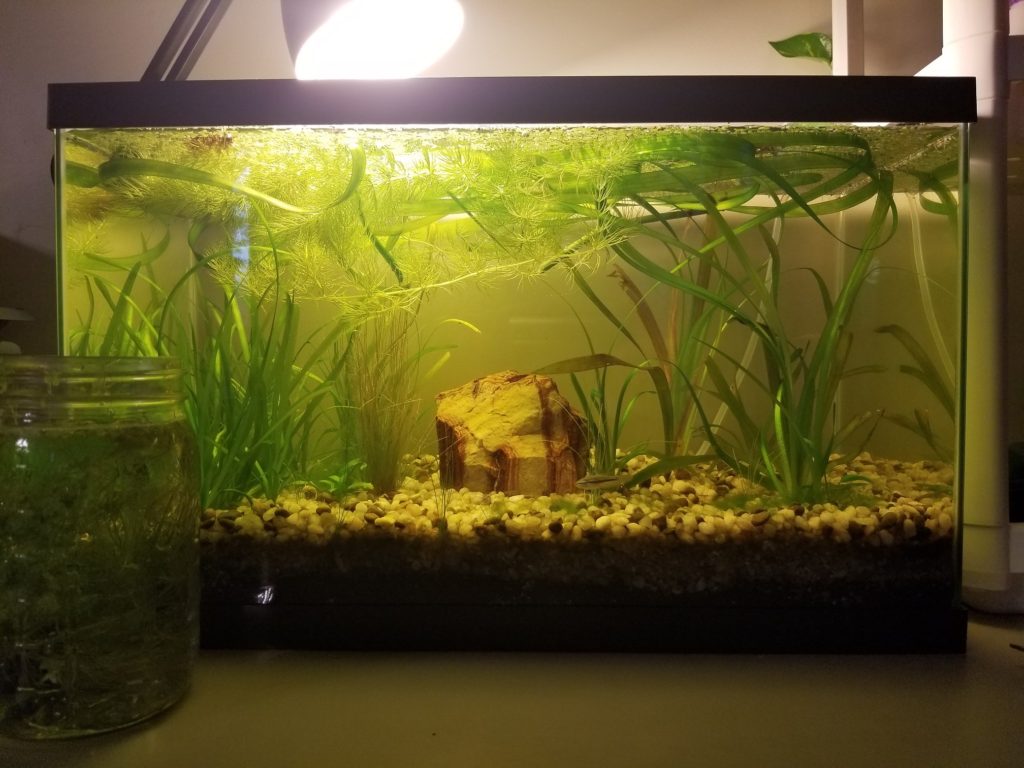
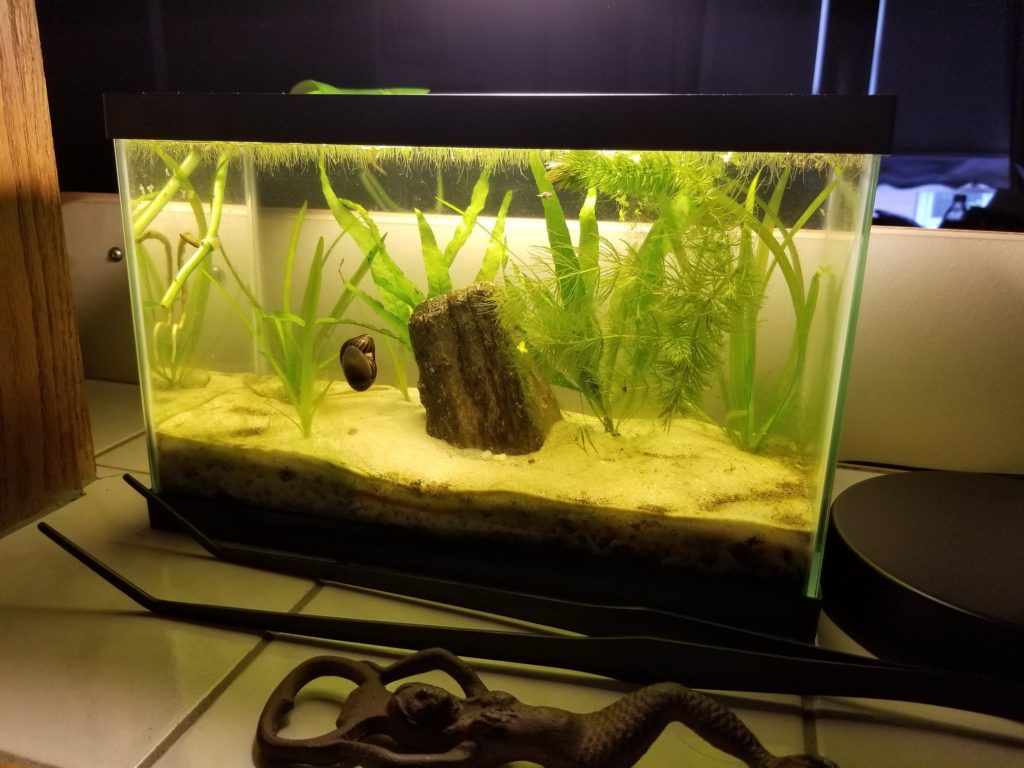
Three months have passed now since I began my aquarium in January. I have checked in on it occasionally, but for the most part I’ve been away at school. Despite my fears that the tank would become a cloudy mass of dead plants and snail shit, it is actually thriving. The set and forget method actually worked! Here is what the tank looks like today:
Planted Aquarium as of April 17, 2021.
There have been a few notable editions since my original post. The bushy pine tree thing growing behind the rock is hornwort. It’s not actually rooted into the gravel back there. In fact, it doesn’t have any roots at all. It’s a floating plant that you could probably find in any standing body of water in New England. Back in early February, I was afraid that I didn’t have enough plants, so a vigorously growing floater like hornwort is a great plant for filling in space and suck up extra nutrients. The plant you see in the above image is actually not the original batch of hornwort that I purchased.
Sometime at the end of January, I visited my local pet supplier in search of plants. They had some brown looking hornwort in an axolotl tank. The axolotls were cute, but the hornwort itself was a bit disgusting. After searching my local waterways in search of wild hornwort for hours to no avail, however, the pet store plants seemed like my only options. Unfortunately, this specimen did not work out. The brown coloration only grew more sickly over the coming days, and it eventually shed all of its needles and died, leaving the floor of my tank a sludgy mess. The fact that I was dosing WAAYYY too much ammonia at this time might have also contributed to the fallout… oops. Thankfully, a friend of a friend happened to have a bunch of hornwort in their own tank and graciously sent me some. I would like to give a shout-out to mailman Noah and his faithful Bronco for delivering that.
Planted aquarium as of February 5, 2021. Note the piles of needles littering the gravel.
This second batch held a vibrant green shade, seemingly much healthier. And it was healthier! This hornwort has thrived in my tank. It has grown so prodigiously that I have had to trim it and disperse it among other jars. I actually set up three other biospheres with the stuff, each hosting a colony of snails. The really astounding thing about the second batch of hornwort, in fact, was that it was carrying snails! Some aquarists consider bladder snails a pest, but they have been an invaluable boon to my tank environment. They are constantly cleaning the surface of the glass of algae, their poop acts as a non-ammonia source of nitrates (I haven’t dosed ammonia since adding them), and they are genuinely really fun to watch as they grow up and slurp around. The poop thing can be a bit gratuitous, though. At least, at first there was a ton of it. They broke down the old hornwort needles, but they replaced the needles carpet with a shit carpet of their own. I think the bacteria in the tank has finally caught up with it, but for a while it was just everywhere. On the bright side, if I did not get these snails, it is possible that my tank would not have cycled very much over the months of my absence.
In the above picture you might notice that the plants look a lot weaker than they did in my original post. The vallisneria on the left in particular pretty much melted. This is normal. The stress of shipping the plant and acclimating to a new water quality causes most plants to die back significantly as they re-calibrate. None of my original plants have actually died. When I visited the pet store, I picked up some cryptocoryne (crypts). Those are the little leafy plants on the left and right sides of the tank. They haven’t grown very much even after three months, and perhaps they never will. In the right environment, however, their leaves, palm-like, can grow quite substantially.
Planted Aquarium as of February 26, 2021.
By the late February, I started to feel like I had a real living thing on my hands. The plants were growing back and propagating, the snails were getting absolutely massive, and the junk in the substrate was actually breaking down. The water was a bit cloudy, though. It has cleared significantly since then, which makes me think that the cloudiness was a temporary side-affect of the cycling process. To this day I have not actually run a test to see if my tank is cycled, so I’ll have to remember to do that before buying any fish.
My dad took an interest in the tank around this time and decided to add a bubbler. You may be able to see the plastic air tube coming out the back there. He was afraid that the tank would grow stagnant without one, and he was probably right. I did notice a little bio-film early on. That’s certainly not a problem anymore. The gas exchange of the bubbles popping might introduce some CO2 to the plants, which is a resource that many planted aquariums have trouble with.
The top of the tank late February. Bubbles and lots of duckweed growth.
A large bladder snail kissing the glass.
Notice the hitchhiker? A damselfly larvae managed to sneak into the tank, possibly with the hornwort.
A month later, things got really wild. The vallisneria had returned to its previous size and began over flowing the top of the tank. It isn’t called “Jungle Vallisneria” for nothing! With enough time and nutrients, the long blades could fold over the entire top of the tank. I hope to see something like that some day. It was turning red, too, which I chock up to not enough soil nutrients. I ought to buy some fertilizer tabs. It should be noted that, between February and March, the light apparently did not turn off. I took the timer off of timer mode and accidentally forgot to switch it back. The plants did not seem to mind, and the hornwort went absolutely crazy, but I also got a ton of hair algae. A shrimp will take care of that someday.
Planted Aquarium as of March 28, 2021.
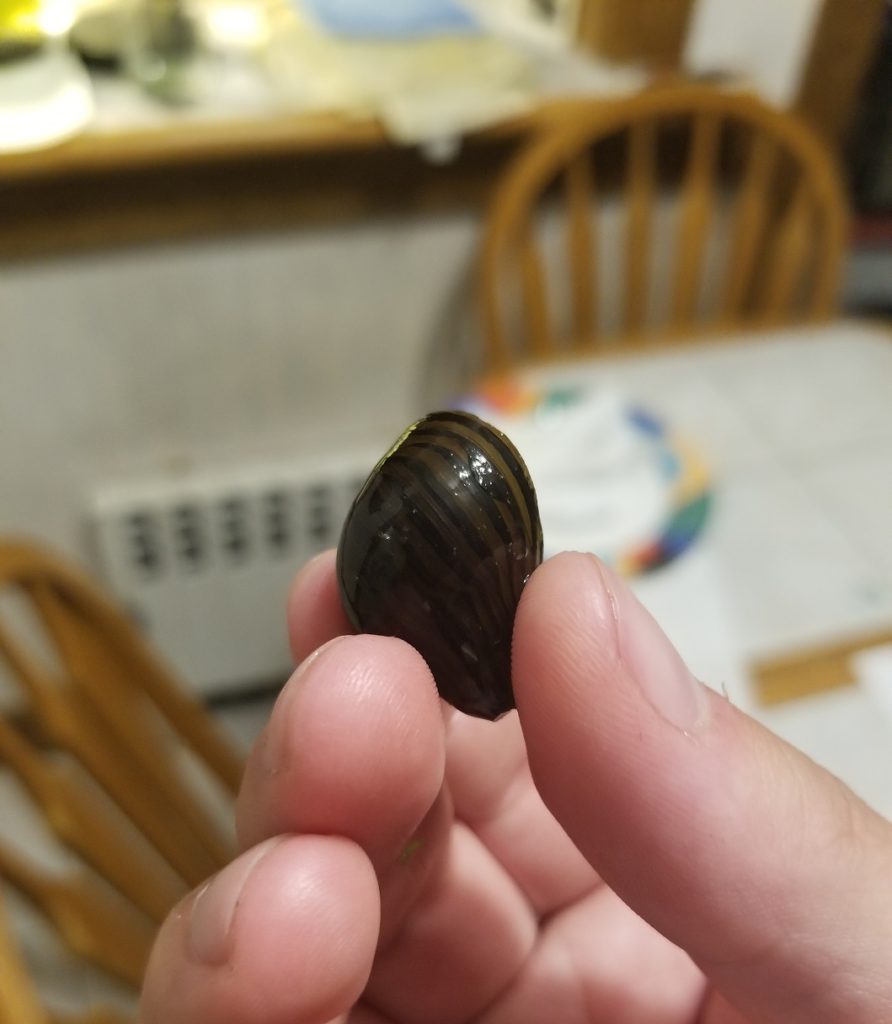
Also, pond snails were not the only variety of mollusk to inhabit my tank. I noticed this behemoth gliding around and pretty much cried:
The king of the snails.
I am optimistic for the future of my aquarium. With graduation on the horizon, however, I suppose I will have to start thinking about what I’m actually going to do with it. I suspect it could endure on its own like this for a year or more, but if I manage to escape my parents’ basement I will want to take it with me. I can also more seriously consider what kind of animal life will be living in it. A betta fish? Larger snails? Shrimps? Minnows?
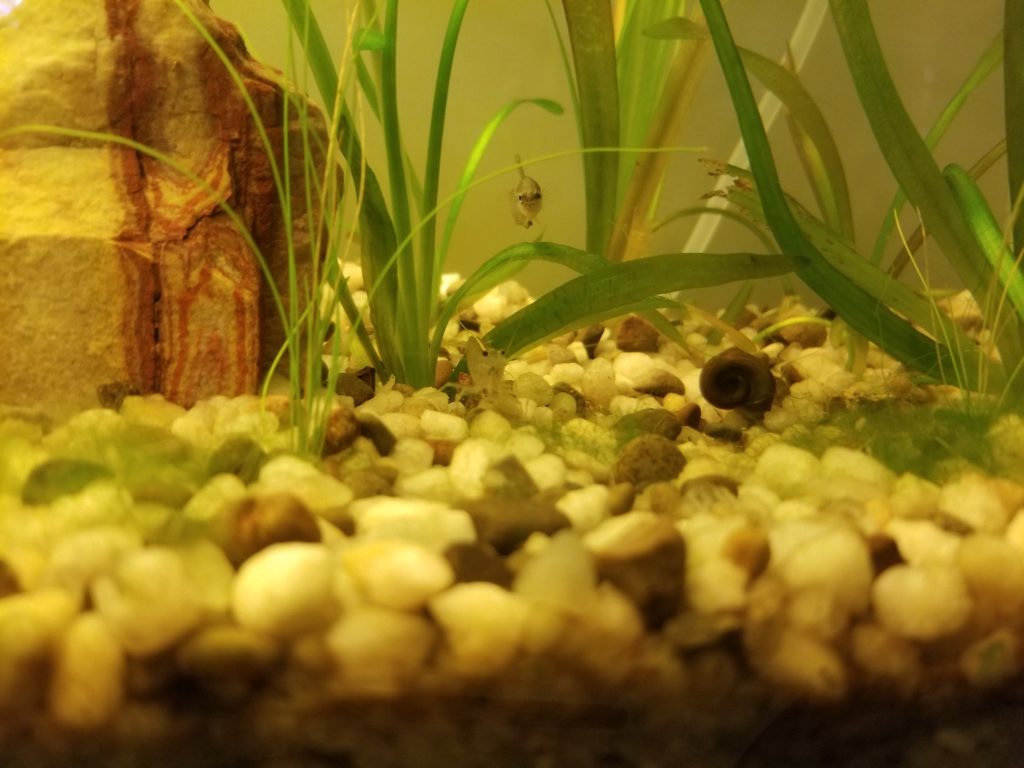
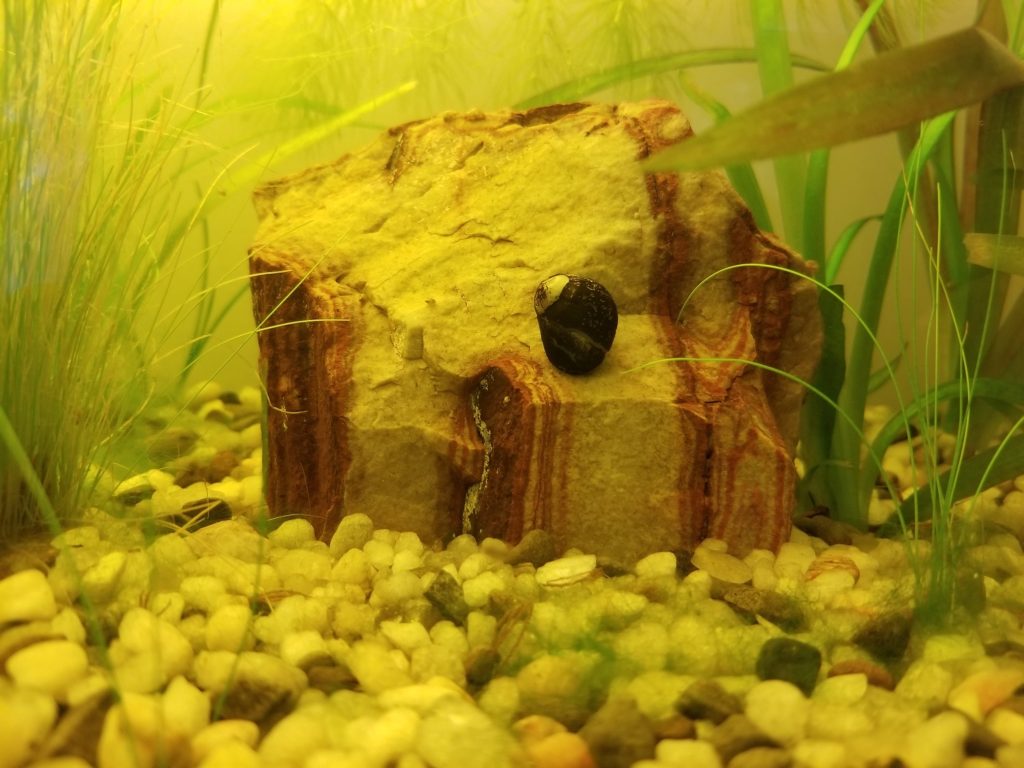
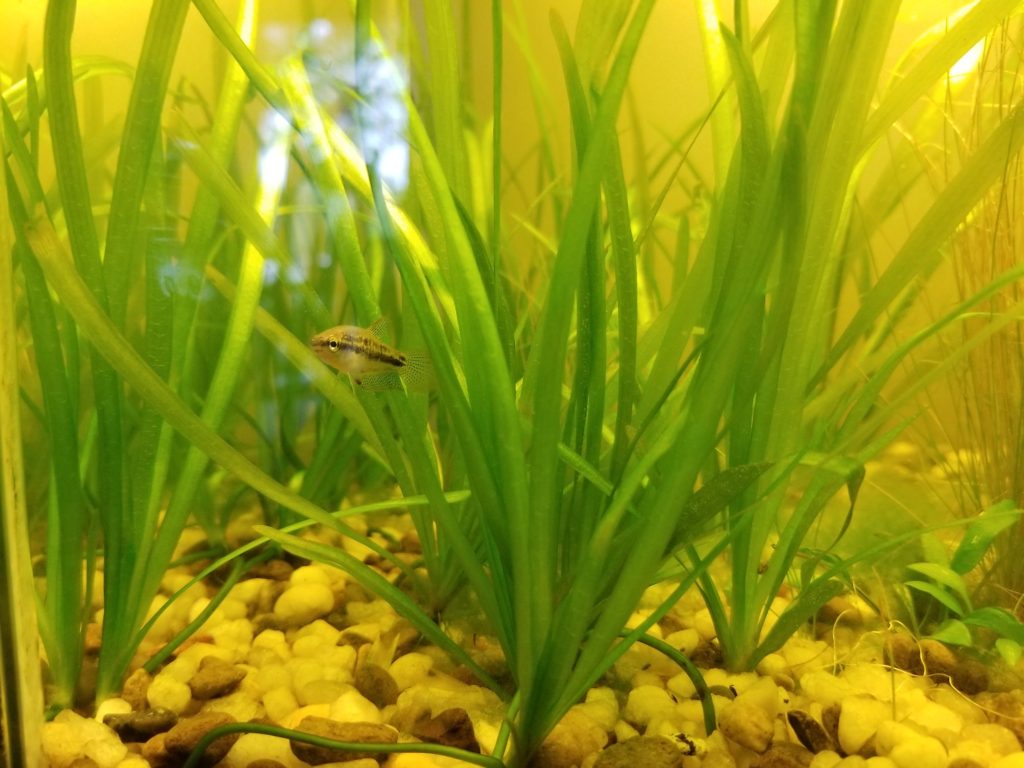
I’ll leave you with this astounding image of a triple snail pileup:
Today marks the 10th anniversary of the Minecraft mod known as Better Than Wolves. I’ve followed the project for almost a decade, and I interact with the community almost daily. I’ve pumped more hours into the game than probably any other activity. It’s hard to explain the appeal of the thing, but basically it is a version of Minecraft with industrialization and mass extinction and tree stumps. It is an immersive and sometimes painful version of the game. Some have described it as “hardcore.”
As a depressing marker of the occasion, Flowerchild officially announced that development of the mod has ended. He will be disengaging from the community and disbanding his social media and forum accounts related to the mod. The plan to step back was actually made known months ago, but I did not quite realize that the end was nigh. This is a pretty emotional event for me, all things considered. I’ve gotten to know many members of the community, and I’ve made many lasting memories playing this game with them. I also feel I owe a debt of gratitude to Flowerchild and the BTW community for fostering a sense of creativity and critical thinking within me. I was like 12 or 13 when I discovered BTW. I basically grew up alongside it. I would say that the crass humor of the players, the wisdom of Flowerchild, and the thoughtful and at times subversive design of the mod itself helped me, for better or worse, develop into the edgy bastard that I am today. I don’t know if my love of literature or analytical drive would be quite so deep had I not discovered this mod.
Screenshot of the new terrain generation in Dawnraider’s Better Terrain Add-on.
With the conclusion of the mod comes the first official release of the BTW source code. Flowerchild, who for years forbid the creation of most add-ons, has given total permission to do whatever the hell we want with his code. This is an incredible turn of events. Players have already been discussing the creation of a kind of mod loader utility for a while, so I suspect add-on development to totally explode. I’m considering opening up some of my own add-on projects and reviving them! To us, BTW is the default Minecraft experience, so it makes sense that we would want to modify it. The potential for new content is unparalleled. Code savvy folks like Dawnraider have already produced amazing content. Her BTA project revamps the 1.5.2 terrain gen to look amazing (though it is strangely reminiscent of, dare I say biased toward, the west coast).
Perhaps somebody could even port the mod to the latest versions of vanilla? A pipe dream, that one.
If you have no idea what Better Than Wolves is and have an interest in trying it out, I am always down to play. Shoot me an email. It’s a hard game, but the experience is so rewarding and immersive. Perhaps I will do a write up of the game someday? I have long dwelled on plans to create a BTW guidebook, but that project never moved past some initial drafts before school work swept me away.
BETTER THAN WOLVES IS DEAD, LONG LIVE BETTER THAN WOLVES! Praise Flowerchild, 420 yolo placenta
(The following is an article that I wrote back in January of 2020 and published in the Brandeis Hoot. Before the pandemic stunted many of my journalistic endeavors, I set myself a goal of documenting and redefining the various arts and artifice that generate my university’s look and appeal. In this case, I reviewed a spectacular plant specimen. It took a little convincing to get my editor to accept that an article about a tree would be fit for the arts section!)
When we think about “art on campus”, most people tend to imagine objects made of paint, canvas, and wood displayed in either the Rose or Dreitzer galleries. The multitude of statues and busts with plaques nailed to them that litter the campus also come to mind, but what about all the stuff that makes up the campus itself? I’m talking about the foundational aesthetic stuff that defines the look and attitude of Brandeis University, its architecture and landscaping. The buildings, walkways, and the decorative plants did not spontaneously generate when Brandeis was founded. On the contrary, almost every object on this campus was the result of a conscious decision made by the interplay of designers, architects, and administrators. We can’t afford to take these easily overlooked aesthetics lightly. Accounting for the landscaping alone, hundreds of thousands of dollars are likely set aside every year to maintain our many acres of lawns, vast array of ornamental trees, and the annual flower beds. I would like to make the case that “art” can extend beyond the gallery and into every aspect of this campus’s design. In short, plants matter.
Observe the Metasequoia, a tree planted between the administrative building and the SCC. It is a fairly nondescript tree, at least at a glance. Careful examination reveals certain irregularities in its features. It is markedly taller than any of the non-oak in the vicinity of Fellows Garden, and its branches sprout from the very base of the trunk, bestowing upon the tree a distinctive triangular or arrowhead-like profile. The girthy lower branches are upturned in apparent exultation as they spiral up the trunk, and at this time of the year (January) they are entirely barren of foliage. This configuration of branches would not be surprising at all on a pine, and while the metasequoia is just as much a needle-bearing conifer as your average Christmas tree, it is not evergreen. In fact, this rare specimen is one of only two species of deciduous conifers within many miles of Brandeis University. The metasequoia will drop its needles just as readily as the birches next to it will drop their leaves when autumn comes around, resulting in the uncanny pine-tree nakedness that you can observe right now.
The height of the metasequoia can be explained by its relation to the giant and coastal sequoias of the west. You’ve seen the textbook pictures from Yosemite. The redwoods of California make up some of the tallest organisms on the planet, boasting trunks so massive that a car can be driven through them. While the metasequoia, also known as the Dawn Redwood, has never been known to reach such insane sizes, it is by no means a small plant. You have probably walked by this tree hundreds of times and had no idea you were passing the only deciduous redwood of the three surviving sequoia species on Earth. The metasequoia’s radical fall coloration makes it the most stylish of its cousins, and I suspect that is why it was allowed to be planted so conspicuously next to the admin building. In marketing a “New England University,” autumn is everything, and the needles of the metasequoia take on brilliant copper-red hues during the fall that compliment the yellow-orange leaves of its neighboring birches. The fact that it remains barren throughout the winter is a secondary bonus–it doesn’t stand out as a lone conifer when the other trees have finished their show. A landscaper is like a painter that employs foliage as his medium, and the metasequoia, which is growing in popularity as an ornamental across the board, is a great addition to the toolkit.
Beyond surface aesthetics, our environmental studies department has good reason to keep a species as scientifically interesting as the metasequoia around. It shares a story with the famous coelacanth, a lobed fish which was thought to be extinct for millions of years but was miraculously discovered alive off the coast of Africa. The metasequoia is another of these “lazarus species,” with fossils indicating that vast forests of these kinds of trees once populated much of the northern hemisphere. In the 1940’s, clusters of living dawn redwoods were discovered in China. The locals had been logging these things for years to build bridges and such, completely unaware that they were in the presence of a scientifically significant, not to mention critically endangered tree. The intervening years saw expeditions for seed collection, and now the endangered metasequoia has a proud home right next to the office of president Liebowitz.
Interest in this tree is not limited to the scientific and landscaping communities. In fact, a certain cult-like interest has grown up around the dawn redwood with private entities taking an extreme interest in the ideal of restoring healthy redwood forests to the eastern United States. A vintage looking HTML website known as dawnredwood.org speaks of one such endeavor that has supposedly been taking place in North Carolina since 1995. Doug Hanks, the sites curator and apparent redwood fanatic, speaks of a project known as the Crescent Ridge Dawn Redwoods Preserve. It is a privately funded attempt to grow a self sustaining metasequoia forest in the most theoretically optimal climate to maximize tree growth. The man is convinced of the economic promise that such a preserve could offer. His website optimistically details his ambitions for the park, which include a pre-planned trail system to mimic “ancient Indian trails”, fairy circles for scenic marriages, and a cable car system to allow tourists to explore the crowns of the yet non-existent mature sequoias. A link at the top of the website leads to an appeal to prospective filmmakers in which he argues that the low cost of living and scenic views of North Carolina could provide a future hotspot for movies. It might be safe to say that this man’s ambitions grow even larger than his favorite trees.
In reality, an eastern redwood forest will likely never match the scale or vigor of the Yosemite sequoias, but the idea is potent enough for the stuff of dreams. Imagine that–our own redwood forest revived from the dregs of a nearly extinct species! It is not hard to see why tree-lovers and scientists alike could be enthralled by the dawn redwood. The Crescent Ridge website optimistically poses that the project could be “completed” by 2035, but I suspect this is a wildly optimistic estimate. In all likelihood, the minds behind this project will be dead long before the trees ever achieve their full potential. Trees do not conform to humanity’s transiently frail sense of time. The dawn redwoods have subsisted for millions of years regardless of human evolution, and they might very well outlast us by a few million more.
In the meantime, we can appreciate what we have. Brandeis students and faculty have easy access to not only a beautiful and rare landscaping piece, but a tree with a potent history and an alluring future. How could such a thing be anything but art? The next time you find yourself speed walking through Fellows Garden to reach your lonely village single, slow down and smell the flowers. Many of them carry a fantastic story.